Create, edit, or delete a user
You can create users directly in ThoughtSpot, or import users and user groups through SAML or similar protocols.
For users who have access through SAML, the SAML installation manages all user information.
Depending on whether you are a cluster administrator or an Org administrator, you have different levels of administrator access. Cluster administrators can see, create, and manage users in any Org. Org administrators can only see, create, and manage users in the Orgs for which they are administrators.
What users can see in each Org
The users listed in Admin settings and in the share dialog depend on the Org you are in:
-
All Orgs view (cluster administrators only): Lists every user on the cluster, including all cluster administrators. A user listed here is not necessarily a member of any particular Org. To confirm whether a user belongs to an Org, switch to that Org and open Admin settings > User management > Users.
-
Primary Org: Lists all users in the Primary Org, including cluster administrators.
-
Any other Org: Lists the users in that Org, except cluster administrators. Each user always sees their own account. This applies to all users in the Org, whether or not they are administrators.
| If your cluster uses the enhanced Admin settings portal, the Users page in a non-Primary Org also lists cluster administrators. The share dialog continues to hide them. |
A cluster administrator is a user who gets the Can administer ThoughtSpot privilege through a group in the Primary Org, either directly or through a nested group or role. An Org administrator gets this privilege through a group inside the Org itself, such as the Org’s administrator group or a custom group created in that Org. Org administrators are not hidden, and they can see each other. For more information, see Administrator visibility across Orgs.
Create a user in ThoughtSpot
This procedure demonstrates how to create a user manually.
A user’s groups determine what they can do in ThoughtSpot. Groups define the user’s privileges, which are the actions they can perform, and the user’s permissions, which are the data they can access. All users automatically belong to the All group. For the privileges and content that the All group and other default groups grant, see Default groups.
Administrators can see all data sources, and row-level security does not apply to them.
To create a new user and assign that user to groups or Orgs, follow these steps:
-
Ensure that you are in the correct Org. If you are a cluster administrator, you can manage all users in all Orgs from the Primary Org. If you are an Org administrator, you must navigate to the specific Org the users you must manage are in. Use the Org switcher to the left of the help menu in the top navigation bar.
-
Go to the Admin settings tab.
-
If you are a cluster administrator in the Primary Org, select All Orgs at the top of the side navigation bar.
-
Select User management > Users from the side navigation bar.
-
Select the Add User button on the upper-right side of the list of users.
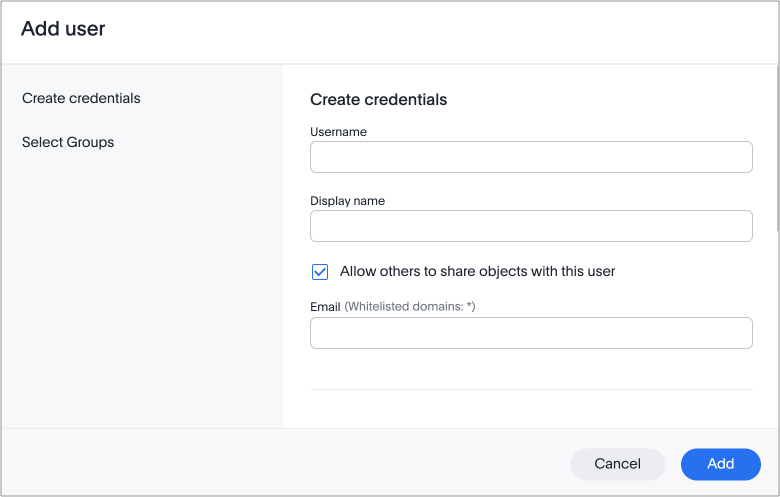
The Add user interface opens.
-
In the Add user interface, scroll or use the left-side menu to navigate to the appropriate section of the dialog, and enter the details for the new user.
-
In the Create credentials section enter the following:
Username, Display name and Email are mandatory fields and cannot be left empty. If you attempt to add a user with the same user name as an existing user you will encounter an error. User names must be unique. - Username
-
A login name for the user. Usernames must be unique and lowercase. If you are using Active Directory to authenticate users, and your LDAP configuration requires users to be created manually (they are not created automatically in ThoughtSpot upon authentication), the username you specify has to be domain-qualified (
username@ldap.thoughtspot.com), and you must enter a dummy password.
- Display name
-
A unique name for the user (usually their first and last name).
-
The user’s email address. ThoughtSpot uses this for notification when another user shares something with them, for onboarding, and others.
During cluster configuration, the administrator specifies the email server domain. ThoughtSpot does not accept emails outside this domain. Contact ThoughtSpot Support to add new domains to a list of allowed domains.
-
In the Select Groups section, Search for or select the desired groups from the list of available groups.
The groups displayed are the groups available in the cluster, or the groups available in the specific org that the user is added to if your organization has org enabled. -
In the Select Orgs section, select the Orgs to add the user to. When you add a user from All Orgs in the Primary Org, this section appears instead of Select Groups. To assign groups, add or edit the user from within the specific Org.
-
-
Click Add to create the user.
| If you add the user to a group that has the Can administer ThoughtSpot privilege, they can see all the data in their Org. If you add the user to a group in the Primary Org that has this privilege, they can see all the data in every Org, and they become a cluster administrator. Cluster administrators are hidden from the user list and the share dialog in other Orgs. For more information, see What users can see in each Org. |
Edit an existing user
As an administrator, you can edit user credentials or modify their group or Org assignments when you edit a user.
|
If your cluster uses a per-Org identity provider (IdP), ThoughtSpot reconciles a user’s Org memberships with the claims from that IdP when the user logs in through it. A manual Org assignment made in Admin settings or through the REST API might not persist if the IdP claims do not include that Org. Logging in through a cluster-wide IdP does not change existing Org memberships. If a user’s Org assignment changes after they log in through a per-Org IdP, check the IdP claim configuration for that user rather than re-adding them manually in ThoughtSpot. For a durable Org assignment, the Org must be included in the IdP claims. Contact your IdP administrator to update the claims. For more information, see Org isolation for per-org SAML authentication and Org-scoped IdP connections. |
To edit an existing user, follow these steps:
-
Ensure that you are in the correct Org. If you are a cluster administrator, you can manage all users in all Orgs from the Primary Org. If you are an Org administrator, you must navigate to the specific Org the users you must manage are in. Use the Org switcher to the left of the help menu in the top navigation bar.
-
Go to the Admin settings tab.
-
If you are a cluster administrator in the Primary Org, select All Orgs at the top of the side navigation bar.
-
Select User management > Users from the side navigation bar.
-
Click the Name of the user in the list to open the Edit User interface. Alternatively, click on the More options menu inline with the user you want to edit.
If you don’t immediately see the username you plan to edit, try searching for it.
-
In the Edit User interface, interface, scroll or use the left-side menu to navigate to the appropriate section of the dialog, and edit the details for the user.
-
In the Create credentials section edit any of the following:
Username, Display name and Email are mandatory fields and cannot be empty. If you attempt to edit a user to have the same user name as an existing user you will encounter an error. User names must be unique. - Username
-
A login name for the user. Usernames must be unique and lowercase. If you are using Active Directory to authenticate users, and your LDAP configuration requires users to be created manually (they are not created automatically in ThoughtSpot upon authentication), the username you specify has to be domain-qualified (
username@ldap.thoughtspot.com), and you must enter a dummy password.
- Display name
-
A unique name for the user (usually their first and last name).
-
The user’s email address. ThoughtSpot uses this for notification when another user shares something with them, for onboarding, and others.
During cluster configuration, the administrator specifies the email server domain. ThoughtSpot does not accept emails outside this domain. Contact ThoughtSpot Support to add new domains to a list of allowed domains.
-
In the Select Groups section, Search for or select or deselect the desired groups from the list of available groups.
The groups displayed are the groups available in the cluster, or the groups available in the specific org that the user is added to if your organization has org enabled. -
In the Select Orgs section, select the Orgs you want to add the user to, and deselect the Orgs you want to remove the user from. When you edit a user from All Orgs in the Primary Org, this section appears instead of Select Groups. To change the user’s groups, edit the user from within the specific Org.
-
-
Click Save.
Preview onboarding
While editing a user, select Preview business user onboarding to evaluate this user’s first experience with ThoughtSpot. After previewing the user’s default data source, you may choose to change the Group assignments.
Groups
Follow these steps to change the user’s groups:
-
In the Edit User interface, select the Groups tab.
-
Select the groups you want to add in the list by clicking the box next to the group name.
-
You can also use Search to find groups by name.
-
Deselect the groups you want to remove from the list by clearing the box next to the group name.
-
Select Update to save changes.
Delete users
To delete users, follow these steps:
-
Ensure that you are in the correct Org. If you are a cluster administrator, you can manage all users in all Orgs from the Primary Org. If you are an Org administrator, you must navigate to the specific Org the users you must manage are in. Use the Org switcher to the left of the help menu in the top navigation bar.
-
Go to the Admin settings tab.
-
If you are a cluster administrator in the Primary Org and want to remove users from multiple Orgs at a time, select All Orgs at the top of the side navigation bar.
-
Select User management > Users from the side navigation bar.

-
Select the users you plan to delete by clicking the box next to the username.
If you don’t immediately see the username you plan to delete, try searching for it.
-
Select Delete in the upper-left corner.
|
A user may exist in multiple Orgs. You can remove a user from multiple Orgs at a time as the cluster administrator, or remove a user from one specific Org as that Org’s administrator. To remove a user from multiple Orgs at a time, the cluster administrator must be in the Primary Org, in Admin settings > All Orgs > User management > Users. |
Add multiple users to an Org
To add multiple users to an Org, you must be a cluster administrator in the Primary Org. Follow these steps:
-
Ensure that you are in the Primary Org. Use the Org switcher to the left of the help menu in the top navigation bar.
-
Go to the Admin settings tab.
-
Select All Orgs at the top of the side navigation bar.
-
Select Org management from the side navigation bar.
-
In the row for the Org, open the Actions menu
 and select Edit.
-
Select Next to go to the Assign users step.
-
Under Select users, select the users you want to add to the Org. You can search for users by name, or use Select all.
To review your selection, turn on Show selected.
-
Select Next.
Troubleshoot user visibility in Orgs
Use the following guidance if a user appears to be missing from an Org or is unexpectedly visible or hidden.
- User is not visible in a specific Org’s Users page
-
If a user can log in successfully but does not appear in a specific Org’s Admin settings > User management > Users page, follow these steps:
-
Check the Org context. Make sure you are viewing the correct Org. Navigate to that Org using the Org switcher, then open Admin settings > User management > Users. The Admin settings > All Orgs > User management > Users view shows all users across all Orgs and does not confirm Org membership.
-
Check whether the user is assigned to the Org. If the user is visible in the All Orgs view but not in the specific Org’s Users page, the user is not a member of that Org. Add the user to the Org using the steps in Edit an existing user or Add multiple users to an Org.
-
Check the per-Org IdP claims. If the user was previously assigned to the Org but lost the assignment after logging in through a per-Org IdP, the IdP claims might not include that Org. See Edit an existing user for details on how per-Org IdPs affect Org membership.
-
- Administrator is not visible in a non-Primary Org’s user list or share dialog
-
This is expected if the administrator is a cluster administrator. In a non-Primary Org, ThoughtSpot hides cluster administrators from all users, except that each user sees their own account.
To check and resolve this:
-
Check where the administrator gets their privileges. If the administrator belongs to a group in the Primary Org that has the Can administer ThoughtSpot privilege, directly or through a nested group or role, they are a cluster administrator and are hidden in other Orgs. This applies even if they only manage one Org.
-
To share objects with hidden administrators, create a group inside the Org, add the administrators to it, and share with that group. Groups are not hidden.
-
To make administrators visible in the Org, add them to the Org’s own administrator group, and remove them from the administrator group in the Primary Org. These users then lose cluster-wide administrator privileges.
-
To manage a cluster administrator account, use Admin settings > All Orgs > User management > Users in the Primary Org. This view lists every user on the cluster, including all cluster administrators.
For more information, see What users can see in each Org.
- User loses an Org assignment after logging in through a per-Org IdP
-
When a user logs in through a per-Org IdP, ThoughtSpot reconciles their Org memberships with the claims from that IdP. If an Org assignment is missing from the IdP claims, it might not persist after the login.
To resolve this:
-
Ask your IdP administrator to add the relevant Org to the user’s IdP claim.
-
Verify the claim is correctly mapped in the ThoughtSpot SAML or OIDC configuration.
-
Once the IdP claim is updated, have the user log in again to trigger the sync.
| Re-adding the user manually in ThoughtSpot without fixing the IdP claims might not be a durable fix. The assignment can change again the next time the user logs in through the per-Org IdP. |
Related information
We highly recommend that you register for the free Multi-Tenancy with Orgs course in ThoughtSpot University that covers the information in this article, and watch the Managing Users & Groups with Orgs lesson.
See other training resources at ThoughtSpot University.

