Create, edit, or delete a user in a multi-tenant environment
You can create users directly in ThoughtSpot, or import users and user groups through SAML or similar protocols.
For users who have access through SAML, the SAML installation manages all user information.
Depending on whether you are a cluster administrator or an Org administrator, you have different levels of administrator access. Cluster administrators can see, create, and manage users in any Org; Org administrators can only see, create, and manage users in the Org(s) for which they are admins.
|
This article contains instructions for managing users if your company does NOT use Identity and Access Management V2 (IAMv2). IAMv2 is off by default. If the Users section of the Admin Console does not contain an Account Activation column, your company is not using IAMv2. If the Users section of the Admin Console contains an Account Activation column, your company is using IAMv2. Refer to Create, edit, or delete a user using IAMv2. |
What administrators can see in each Org
The users you see in the Admin Console depend on your administrator role and on the Org you are in:
-
All Orgs view (cluster administrators only): Lists every user on the cluster. A user listed here is not necessarily a member of any particular Org. To confirm whether a user belongs to an Org, switch to that Org and open Admin > User management > Users.
-
Cluster administrators in a non-Primary Org: See the users in that Org and their own cluster admin account. Other cluster admin accounts are hidden, even if those administrators have access to the Org.
-
Org administrators: See their own account and all other users in their Org, including other Org administrators. They do not see cluster administrators.
A cluster administrator is a user who belongs to a group with the Has administration privileges privilege in the Primary Org. ThoughtSpot hides cluster administrators from Org user lists so that users in an Org, who are often your own customers, do not see cluster-level accounts. For more information, see Administrator visibility across Orgs.
Create a user in ThoughtSpot
This procedure demonstrates how to create a user manually. When you create a user, you can specify the username, display name, sharing visibility, the password, email, whether they get a welcome email and its text, and assign group memberships. The user inherits privileges and permissions directly from the group assignments.
Note that all users automatically belong to the group All.
To create a new user and assign that user to groups or Orgs, follow these steps:
-
Ensure that you are in the correct Org. If you are a cluster administrator, you can manage all users in all Orgs from the Primary Org. If you are an Org administrator, you must navigate to the specific Org the users you must manage are in. Use the Org Switcher to the left of the help menu in the top navigation bar.
-
Navigate to the Admin Console by selecting the Admin tab from the top navigation bar.
-
If you are a cluster administrator in the Primary Org, select All Orgs from the side navigation bar.
-
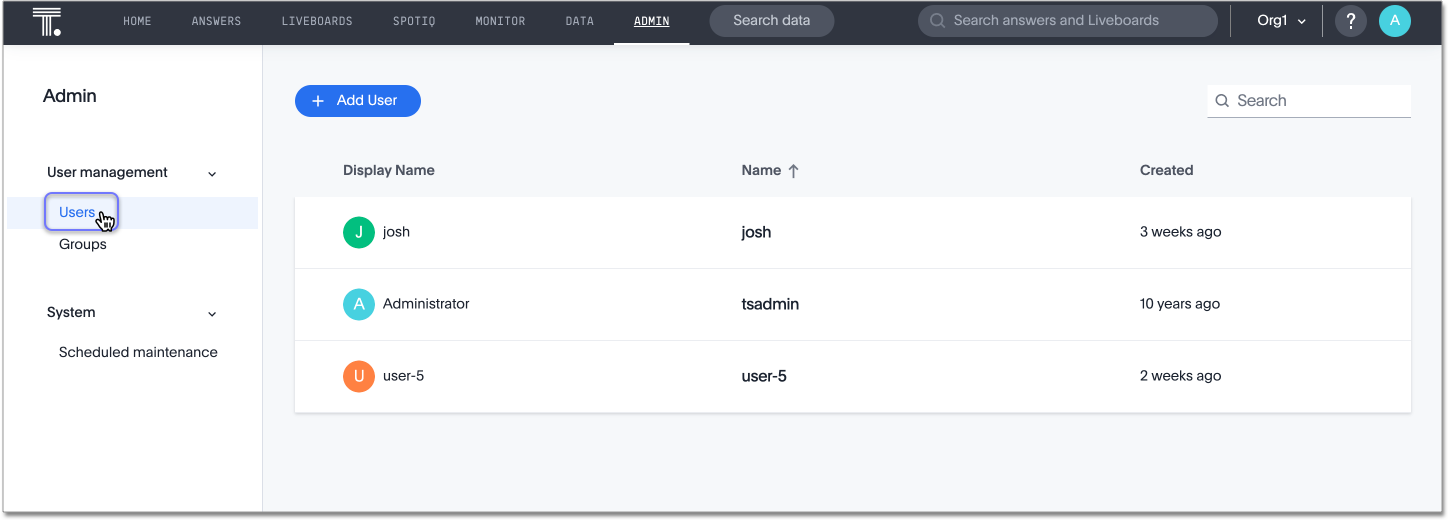
Select User management > Users from the side navigation bar that appears.
-
Select the + Add User button on the upper-left side of the list of users.
-
In the Add a new user interface, enter the details for the new user.
You see a different interface, depending on whether you are adding the new user from the All Orgs section of the Admin Console, or from a specific Org. From All Orgs, you can add the new user to multiple Orgs. From the specific Org, you can add the new user to groups. 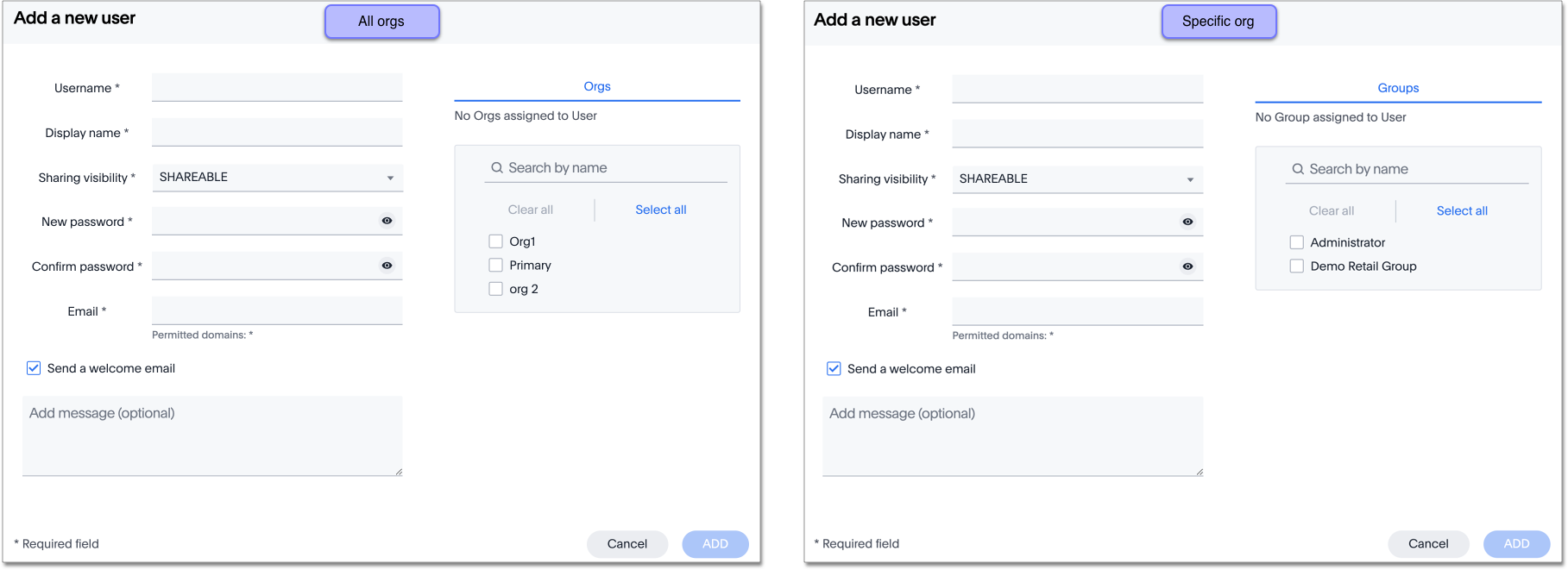
- Username
-
A login name for the user. Usernames must be unique and lowercase. If you are using Active Directory to authenticate users, and your LDAP configuration requires users to be created manually (they are not created automatically in ThoughtSpot upon authentication), the username you specify has to be domain-qualified (
username@ldap.thoughtspot.com), and you must enter a dummy password.
- Display name
-
A unique name for the user (usually their first and last name).
- Change password
-
Add or change the password. Your password must meet the following requirements:
-
The password must be 8 characters or more in length.
-
The password must include at least 1 uppercase letter, 1 lowercase letter, 1 number, and 1 special character.
-
The password must pass a complexity test based on an external library. This test ensures password complexity and uniqueness by checking for known patterns or words that are too simple. If the password is not complex enough, ThoughtSpot rejects it, even if it fulfills the other requirements. Refer to the Dropbox password library for more information.
-
The password cannot use certain blocked words. By default, the blocked words are: your username, any part of your display name, and any blocked words your company configures. To add additional words to the blocklist, contact ThoughtSpot Support.
-
- Confirm password
-
Enter the password again.
-
The user’s email address. ThoughtSpot uses this for notification when another user shares something with them, for onboarding, and others.
During cluster configuration, the administrator specifies the email server domain. ThoughtSpot does not accept emails outside this domain. Contact ThoughtSpot Support to add new domains to a list of allowed domains.
- Send a welcome email
-
(Optional) When checked, this option ensures that the new user receives a welcome email. You can customize other aspects of the onboarding email, such as the email address ThoughtSpot sends it from, from the Onboarding section of the Admin Console. Refer to Managing email and onboarding settings.
- Email message text
-
(Optional) Enter text of the optional welcome email here.
- Groups
-
(Recommended) Select the groups for the user. This option appears when you add a user from a specific Org.
When you create a new user, the groups they belong to define the following attributes for the user:
- Privileges
-
the actions they can perform, defined when you add a group and set security privileges
- Permissions
-
the data they can access and view, defined when you consider data security
Administrators can see all data sources, and row-level security does not apply to them.
If you add the user to a group that has the privilege Has administration privileges, they can see all the data in their Org. If you add the user to a group in the Primary Org that has the privilege Has administration privileges, they can see all the data in every Org. - Orgs
-
(Recommended) Select the Org(s) for the user. This option appears when you add a user from the All Orgs section of the Admin Console in the Primary Org.
-
Select Add to create the user.
Note that this process of identifying the user’s needs contributes to a robust onboarding process. See Onboarding users.
Edit an existing user
As an administrator, you can edit a user account, and change the user’s groups or Orgs. You can also help users by resetting their password, and evaluating their onboarding experience to ensure they receive the best possible introduction to relevant information in ThoughtSpot.
To edit an existing user, follow these steps:
|
If your cluster uses a per-Org identity provider (IdP), ThoughtSpot reconciles a user’s Org memberships with the claims from that IdP when the user logs in through it. A manual Org assignment made in the Admin Console or through the REST API might not persist if the IdP claims do not include that Org. Logging in through a cluster-wide IdP does not change existing Org memberships. If a user’s Org assignment changes after they log in through a per-Org IdP, check the IdP claim configuration for that user rather than re-adding them manually in ThoughtSpot. For a durable Org assignment, the Org must be included in the IdP claims. Contact your IdP administrator to update the claims. For more information, see Org isolation for per-org SAML authentication and Org-scoped IdP connections. |
-
Ensure that you are in the correct Org. If you are a cluster administrator, you can manage all users in all Orgs from the Primary Org. If you are an Org administrator, you must navigate to the specific Org the users you must manage are in. Use the Org Switcher to the left of the help menu in the top navigation bar.
-
Navigate to the Admin Console by selecting the Admin tab from the top navigation bar.
-
If you are a cluster administrator in the Primary Org, select All Orgs from the side navigation bar.
-
Select User management > Users from the side navigation bar that appears.
-
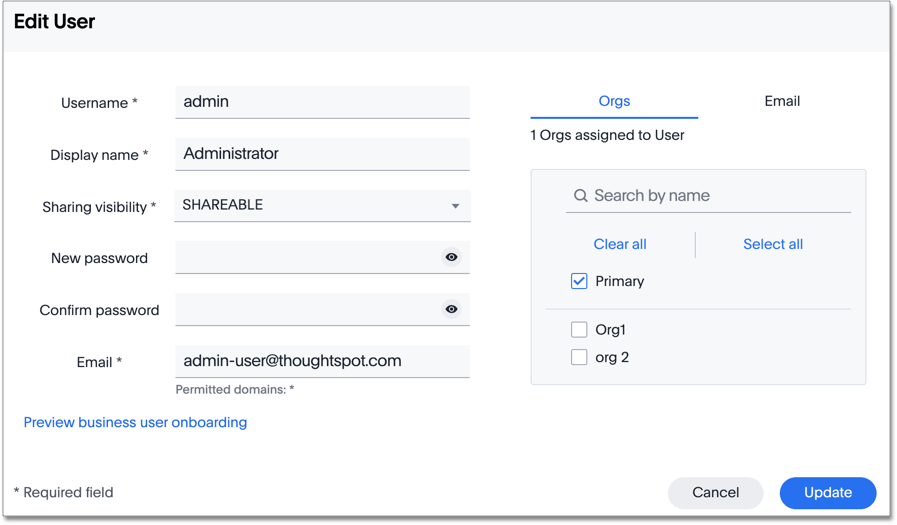
Select the username in the list to open the Edit User interface.
If you don’t immediately see the username you plan to edit, try searching for it.
-
In the Edit User interface, edit the basic user information.
You see a different interface, depending on whether you are editing the user information from the All Orgs section of the Admin Console, or from a specific Org. From All Orgs, you can edit Orgs the user is in. From the specific Org, you can edit the groups the user is in. You can change the username, display name, sharing visibility, passwords, and user’s email.
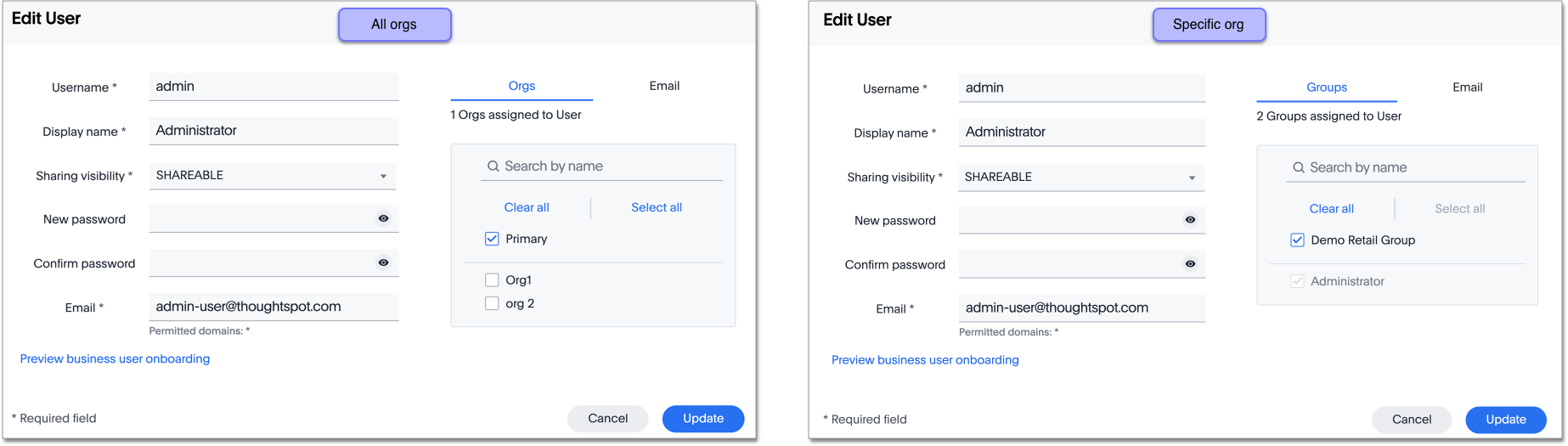
You can also preview onboarding, and make changes to the Groups or Orgs assigned to the user, depending on where you are editing the user information.
-
Select Update.
Preview onboarding
You can select Preview business user onboarding to evaluate this user’s first experience with ThoughtSpot. After previewing the user’s default data source and Liveboards, you may choose to change the Group assignments.
Groups
Follow these steps to change the user’s groups:
-
Ensure that you are editing the user from the specific Org the user is in.
-
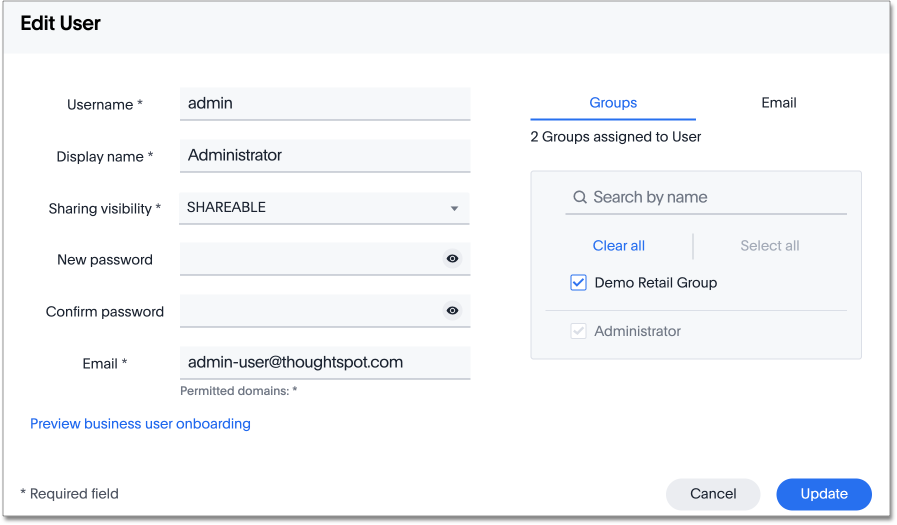
Select the Groups tab.
-
Select the groups you want to add in the list by clicking the box next to the group name.
-
You can also use Search to find groups by name.
-
Deselect the groups you want to remove from the list by clearing the box next to the group name.
-
Select Update to save changes.
Orgs
Follow these steps to change the Orgs the user is in:
-
Ensure that you are editing the user from the All Orgs section of the Admin Console.
-
Select the Orgs tab in the Edit User interface.
-
Select the Org(s) you want to add in the list by clicking the box next to the Org’s name.
-
You can also use Search to find Orgs by name.
-
Deselect the Orgs you want to remove from the list by clearing the box next to the Org’s name.
-
Select Update to save changes.
Delete users
To delete users, follow these steps:
-
Navigate to the Admin Console by selecting on the Admin tab from the top navigation bar.
-
Select User management > Users from the side navigation bar that appears.
-
Select the users you plan to delete by clicking the box next to the username.
If you don’t immediately see the username you plan to delete, try searching for it.
-
Select Delete in the upper-left corner.
|
A user may exist in multiple Orgs. You can remove a user from multiple Orgs at a time as the cluster administrator, or remove a user from one specific Org as that Org’s administrator. To remove a user from multiple Orgs at a time, the cluster administrator must be in the Primary Org, in the All Orgs > User management > Users section of the Admin Console. |
Add multiple users to an Org
To add multiple users to an Org, you must be on the All Orgs section of the Users interface. Follow these steps:
-
Ensure that you are in the Primary Org. Use the Org Switcher to the left of the help menu in the top navigation bar.
-
Navigate to the Admin Console by selecting on the Admin tab from the top navigation bar.
-
Select All Orgs in the left navigation bar.
-
Select User management > Users.
-
Select the names of users you plan to add to Orgs by clicking the box next to the username.
If you don’t immediately see the username, try searching for it.
-
Select the Add to org button above the list of users.
-
In the Add to org interface, open the dropdown menu.
-
Select an Org, or use the search bar to find an Org and select it.
-
Select Save.
Troubleshoot user visibility in Orgs
Use the following guidance if a user appears to be missing from an Org or is unexpectedly visible or hidden.
- User is not visible in a specific Org’s Admin > User management > Users page
-
If a user can log in successfully but does not appear in a specific Org’s Admin > User management > Users page, follow these steps:
-
Check the Org context. Make sure you are viewing the correct Org. Navigate to that Org using the Org switcher, then open Admin > User management > Users. The All Orgs > User management > Users view shows all users across all Orgs and does not confirm Org membership.
-
Check whether the user is assigned to the Org. If the user is visible in All Orgs > User management > Users but not in the specific Org’s Admin > User management > Users, the user is not a member of that Org. Add the user to the Org using the steps in Orgs or Add multiple users to an Org.
-
Check the per-Org IdP claims. If the user was previously assigned to the Org but lost the assignment after logging in through a per-Org IdP, the IdP claims might not include that Org. See Edit an existing user for details on how per-Org IdPs affect Org membership.
-
- Cluster admin account is not visible in a non-Primary Org
-
This is expected. In a non-Primary Org, ThoughtSpot shows only the cluster admin account used to log in to the current session.
-
To manage another cluster admin account, use All Orgs > User management > Users in the Primary Org. This view lists every user on the cluster, including all cluster admin accounts.
-
To see a specific cluster admin account in a non-Primary Org, log out, log in with that account, and switch to the Org using the Org switcher.
-
For more information, see What administrators can see in each Org.
- User loses an Org assignment after logging in through a per-Org IdP
-
When a user logs in through a per-Org IdP, ThoughtSpot reconciles their Org memberships with the claims from that IdP. If an Org assignment is missing from the IdP claims, it might not persist after the login.
To resolve this:
-
Ask your IdP administrator to add the relevant Org to the user’s IdP claim.
-
Verify the claim is correctly mapped in the ThoughtSpot SAML or OIDC configuration.
-
Once the IdP claim is updated, have the user log in again to trigger the sync.
| Re-adding the user manually in ThoughtSpot without fixing the IdP claims might not be a durable fix. The assignment can change again the next time the user logs in through the per-Org IdP. |